
Want the exact RTP before you spin? Here’s the honest answer
BGaming publishes the RTP for Bonanza Billion Merge Up+: 97.04%. That figure appears on the studio’s own game page and in the launch coverage, and it puts the house edge at 2.96%. One caveat worth knowing before you load it: BGaming’s site also lists a 96.98% configuration, because studios routinely ship more than one RTP build of the same slot and operators choose which one to run. So check the game’s info panel at your casino to confirm which version you’re actually playing.
What the launch tells us beyond the number is the more interesting part anyway: this is the Bonanza Billion series wearing a reworked version of BGaming’s trademark Merge Up mechanic. That mechanic, not the theme, is the reason this release is worth a look.
What is Bonanza Billion Merge Up+?
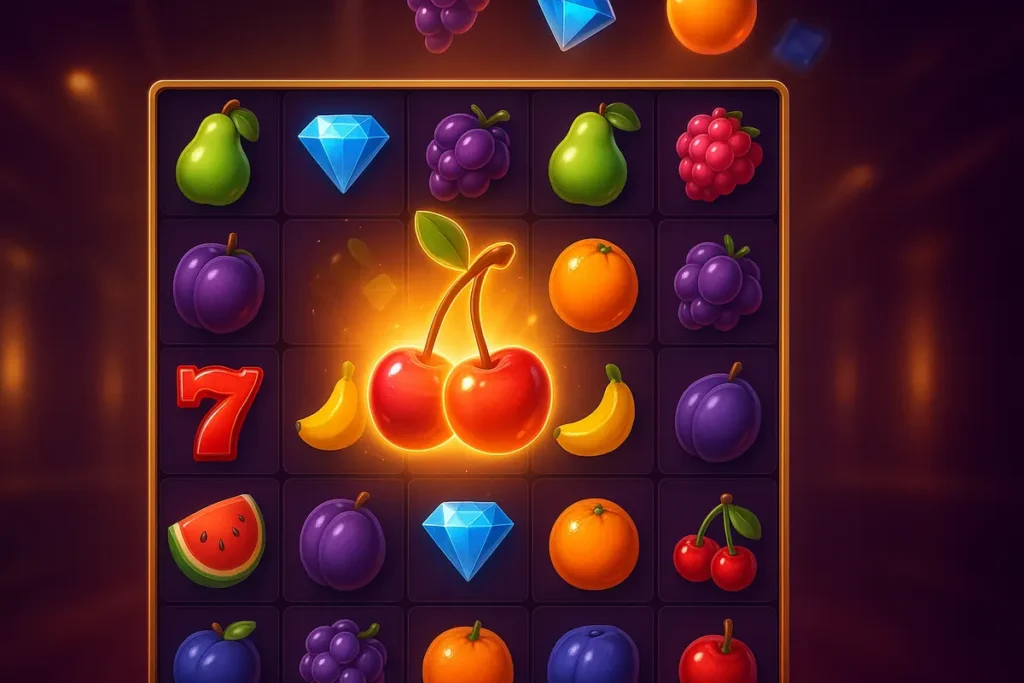
Bonanza Billion Merge Up+ is a fruit-themed video slot from BGaming, released on 24 September 2026 as the newest entry in the studio’s Bonanza Billion line. It keeps the bright fruit-and-gem look players already know from that series and layers on an upgraded take on BGaming’s Merge Up mechanic, which the studio says was reworked to fix a shortcoming in the original version.
So it’s a hybrid: familiar aesthetic, new maths. If you’ve played anything in the Bonanza Billion family, the symbols will feel like old furniture. The way wins build will not.
How the Merge Up mechanic works
In plain terms, a merge mechanic takes matching low-value symbols sitting next to each other and combines them into fewer, bigger symbols. Instead of two cherries paying two cherries, they fuse into one upgraded tile that carries more weight in the paytable. The grid gets tidier and the surviving symbols get more valuable.
The symbol merging process
Step by step, a merge round in a game of this type runs like this:
- Symbols land on the grid after a spin.
- The game checks for groups of identical adjacent symbols that qualify for a merge.
- Those symbols collapse into a single higher-tier symbol in place of the group.
- Any winning combination present after the merge is evaluated and paid.
- Empty positions are refilled, and the game checks again.
Worked example: three plums drop in a cluster. Rather than each plum counting separately, they merge into one upgraded plum tile. You now hold fewer symbols but a stronger one, and that upgraded tile may be exactly what a paying cluster needed. That’s the trade the mechanic asks you to accept, and it’s why merge slots feel different from ordinary tumble slots even when the base theme is identical.
The “+” in the title signals the reworked build. BGaming’s own framing is that the original Merge Up had an issue worth solving; the studio has not spelled out the fix in the launch note, so treat the specific improvement as something to read in the game’s rules screen rather than in a review.
Cascade effects
Merging leaves gaps, and gaps get filled. New symbols drop into the vacated positions, which can create fresh adjacent groups, which can merge again. That chain is what players usually mean by cascading reels or tumbles: one paid spin can resolve into several consecutive evaluations before the round closes.
Two things matter here. First, cascades make individual rounds longer and streakier, because a single spin can do nothing at all or resolve four or five times. Second, and this is the part people misread, cascades don’t add value out of thin air. The studio prices them into the game’s return. A slot with long, dramatic chains pays for that drama with more dead spins in between.
RTP and volatility: what’s published and what to verify
RTP (return to player) is the share of all money wagered that a game returns over millions of rounds. At the published 97.04%, about ₹97 comes back per ₹100 staked on average across the long run, leaving a house edge of 2.96%. That average is a property of the game, not of your session. Two hundred spins tell you almost nothing about it. On the 96.98% build the edge is 3.02% instead, which is a small difference on paper and a real one over tens of thousands of spins.
Volatility describes how that return is distributed. High volatility means rarer, larger wins and deeper stretches of nothing. Low volatility means smaller, more frequent wins. Volatility never changes RTP, it only changes how bumpy the ride is. Merge-and-cascade designs typically land on the swingier end, because value concentrates into fewer, bigger resolutions, but treat that as a design tendency rather than a confirmed rating for this title.
Here’s how to read the spec sheet for this release honestly:
| Spec | Status at launch | Where to confirm |
|---|---|---|
| Provider | Confirmed: BGaming | Game info screen |
| Release date | Confirmed: 24 September 2026 | BGaming release announcement |
| Series | Confirmed: Bonanza Billion line | BGaming game catalogue |
| Core mechanic | Confirmed: reworked Merge Up | In-game rules screen |
| RTP % | Published: 97.04% (a 96.98% build is also listed) | BGaming game page, then the paytable / info panel at your casino |
| Volatility rating | Not published in the launch note | Paytable / info panel |
| Max win multiplier | Not published in the launch note | Paytable / info panel |
| Bet range | Casino dependent | Bet selector in game |
For bankroll planning, work from stake size rather than from hope. If a session budget is ₹2,000 and you want it to survive a few hundred spins on a swingy game, your unit stake needs to be small, in the region of ₹5 to ₹10, not ₹50. The arithmetic is unglamorous and it’s the only part of a slot session you actually control. Our RTP and volatility explainer goes deeper on the maths if you want the full picture.
How cluster pays and win formation work
Cluster pays replaces fixed paylines. Instead of matching symbols along a set line from left to right, you need a group of identical symbols touching each other, usually horizontally and vertically, anywhere on the grid. Most cluster slots set a minimum group size, commonly five or more symbols, and pay progressively more as the group grows, with the biggest awards reserved for very large clusters.
Win calculation is straightforward once you’ve read the paytable: the symbol type and the cluster size give you a multiple of your total bet. Land a bigger cluster of a higher-tier symbol and the multiple climbs. Any multiplier feature the game applies on top is then multiplied against that base amount rather than added to it.
Why cluster pays and merging fit together so neatly: merging creates adjacency. Every time a group of low symbols collapses into one upgraded tile, the geometry of the grid changes and new touching groups become possible. That’s the design logic behind pairing the two systems, and it’s why the payout distribution in a game like this is lumpier than in a 20-line classic. If cluster scoring is new to you, start with our guide to cluster pays slots.
Grid, symbols and features
The Bonanza Billion presentation carries over: stacked fruit symbols, gem-style higher payers, saturated colour and a fast, arcade-ish spin rhythm. Fruit is the visual anchor of the series, and the marketing language around the launch leans on the same harvest idea.
Because BGaming’s announcement focuses on the mechanic rather than the full feature list, the details worth checking yourself in the info panel are:
- Grid dimensions and whether the layout expands during a round.
- Minimum cluster size required to pay, per symbol tier.
- Which symbols can merge and how many merge tiers exist.
- Whether multipliers are applied per cascade, per round, or only in a bonus.
- Scatter or bonus symbol requirements for free spins, if the game includes them.
- Any buy-feature option, and the cost in multiples of your stake.
One editorial note on buy features, wherever you meet them: paying 100x your stake to enter a bonus round doesn’t improve your odds. It compresses the same negative expectation into fewer, larger transactions. Convenient, sometimes entertaining, never an edge.
Who BGaming is
BGaming is a slots and instant-games studio that grew out of SoftSwiss’s in-house games division and has traded under the BGaming name since 2018. It built its reputation in the crypto and hybrid casino market, where it became one of the more visible suppliers, and it’s known for shipping recognisable characters and mechanics rather than one-off titles.
Recognisable releases include Elvis Frog in Vegas, Dig Dig Digger, Book of Cats, Space XY and the original Bonanza Billion, which is why a Merge Up+ entry in that series arrives with a built-in audience. Like other regulated suppliers, BGaming submits its RNG and game maths for testing by independent laboratories and supplies licensed operators; if you want the certification and licensing specifics, they’re published on the studio’s own site and referenced in the game’s help files rather than in press releases. For context on how the studio’s other games behave, browse our BGaming slot reviews.
Frequently asked questions
What is Bonanza Billion Merge Up+?
A fruit-themed BGaming slot released on 24 September 2026, combining the Bonanza Billion series look with a reworked version of the studio’s Merge Up mechanic.
How does the merge mechanic work?
Adjacent identical symbols combine into a single higher-tier symbol, the game pays any resulting winning cluster, then new symbols drop into the empty positions and the check repeats.
What is the RTP of Bonanza Billion Merge Up+?
BGaming publishes an RTP of 97.04%, which is a house edge of 2.96%. A 96.98% configuration is also listed, so open the game’s info panel at your casino to read the exact percentage that applies to the version you’re playing.
Is Bonanza Billion Merge Up+ high volatility?
No official rating was published at launch. Merge-plus-cascade designs generally sit on the higher-volatility side, but check the game’s own description before assuming.
Before you play
Read the paytable, confirm the RTP your casino is running, set a deposit or loss limit, and treat the stake as the price of entertainment. Every slot carries a house edge, so no mechanic, merge or otherwise, turns one into an income. If play stops feeling like a choice, use the deposit limits, cool-off and self-exclusion tools in your account. Players in India can also reach free, confidential support through local helplines such as those run by TISS iCall. Gambling is for adults only, and the minimum legal age is not the same everywhere: it is 18 in some jurisdictions and 21 in many others, including most US states and, by several published sources, India. Check the rule that applies where you are rather than assuming a blanket 18+ threshold.