
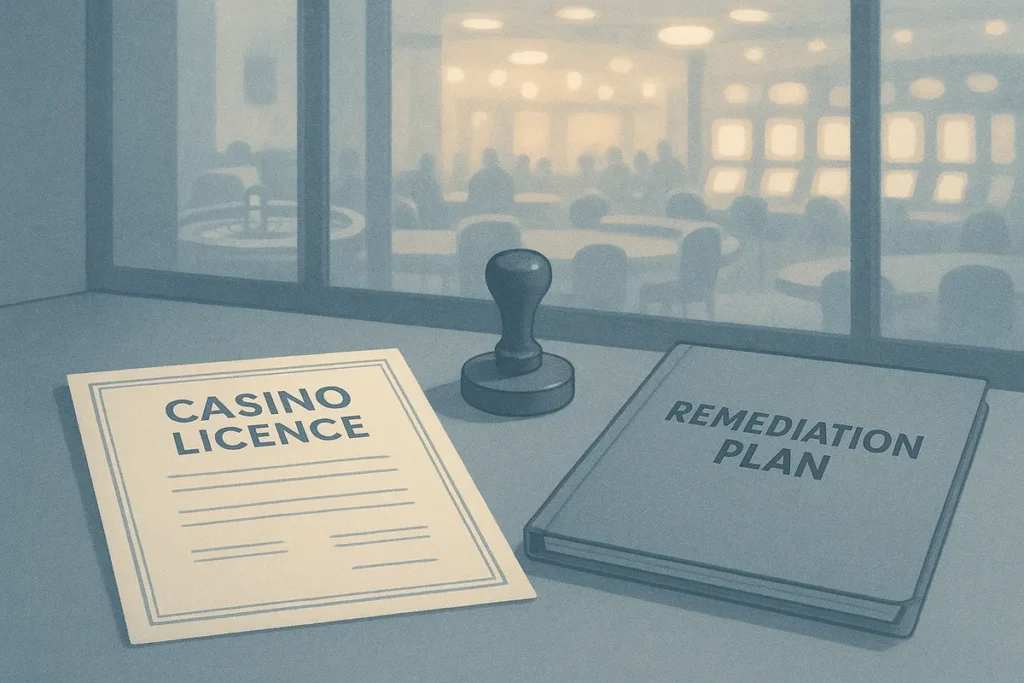
The doors at Broadbeach never closed. Staff turned up for their shifts, the tables opened, the loyalty desk kept handing out cards. Yet on paper, The Star Gold Coast was supposed to have gone dark for 90 days from 30 September 2026. Instead, the Queensland government pushed the date back again, this time to 31 March 2027.
That gap between a suspension being ordered and a suspension actually happening is the single most useful thing to understand about casino licence suspension. Regulators rarely flip a switch. They build a ladder of pressure, and a deferred suspension sits near the top of it: the penalty is real, signed and dated, but held in reserve while the operator fixes what it broke. Understanding where an operator sits on that ladder tells you far more about its health than any headline.
The Star Gold Coast: a suspension that keeps being postponed
The short version: The Star Gold Coast’s casino licence was due to be suspended for 90 days from 30 September 2026. In late September 2026, the Queensland government extended the deferral of that suspension to 31 March 2027, after reviewing the latest independent advice from the Special Manager appointed to watch over the casino, Nicholas Weeks.
The reasoning behind the six-month extension matters more than the date. In his August report, Weeks acknowledged that The Star had made significant progress across its main remediation and reform programme, while flagging that several priority remediation matters were still in progress. He also pointed to organisational and financial reforms put in place since his previous report. The government weighed that report plus supplementary advice, and concluded that letting the work continue was more useful than closing the doors.
Two things are happening at once here. The deferral gives The Star room to finish the commitments in its remediation plan. It also keeps the Special Manager in place, independently observing whether the reforms actually work in practice rather than on a slide deck. That observation feeds the next decision about the casino’s operations, which is precisely why deferrals get renewed in six-month blocks rather than waved away permanently.
The underlying situation is that a state review concluded the operator fell short of the standards expected of a licence holder, a suspension was ordered as the sanction, and the suspension has since been held back while remediation is monitored. Nothing has been cancelled. The suspension is parked, not deleted.
How a casino licence suspension works
A licence is permission to operate, granted on the condition that the holder stays suitable. Regulators can withdraw or restrict that permission, but in most mature jurisdictions they have to follow a process that gives the operator notice and a right of reply. That process is slow by design, because shutting a large casino has consequences for thousands of employees, suppliers and, in many cases, state tax revenue.
From investigation to decision
The sequence is broadly consistent across jurisdictions, whether it is Queensland, the UK Gambling Commission, the Malta Gaming Authority or a state gaming board:
- Trigger. A complaint, a whistleblower, a bank’s suspicious activity report, media reporting, a failed audit or routine compliance monitoring raises a flag.
- Information gathering. The gaming authority requests records, transaction data, customer interaction logs and internal policies. Section-style statutory notices compel disclosure.
- Formal review or inquiry. For serious cases, an independent inquiry or review is commissioned, often with public hearings and a published report on whether the operator remains suitable to hold the licence.
- Show cause. The operator is told what findings the regulator has reached and invited to respond before any sanction is imposed. This is the stage where remediation plans get offered.
- Decision and sanction. The regulator or minister imposes an outcome: conditions, a financial penalty, a suspension, or in the worst cases cancellation.
- Supervision. Sanctions frequently come with ongoing oversight, such as an independent monitor or Special Manager, plus reporting deadlines and review points.
- Appeal or review. Operators can usually challenge decisions through a tribunal or court, which adds months.
Most enforcement never reaches step five in a dramatic way. It ends in a settlement, a fine and a set of new licence conditions.
Suspension, revocation and conditions are not the same thing
People use these terms interchangeably and they mean very different futures for a business.
- Licence conditions: the licence continues but with added obligations, such as mandatory player spend checks, third party audits or capped operations. Least disruptive, and the most common outcome.
- Suspension: permission to operate is paused for a defined period or until conditions are met. Gaming stops, wages usually don’t. Customer balances are typically protected and returnable, depending on the jurisdiction’s rules.
- Revocation or cancellation: the licence is withdrawn. The business either sells the asset or winds down. This is the terminal outcome.
- Deferred suspension: the suspension is formally decided but its start date is pushed back, conditional on progress. It is a loaded weapon with the safety on.
What triggers a licence review
Reviews rarely start over one bad night. They start when a pattern suggests the operator’s controls do not work. The recurring triggers:
- Anti money laundering failures. Weak source of funds checks, tolerating cash structuring, accepting junket or third party money without scrutiny, or failing to file suspicious matter reports. AML is the single biggest driver of large casino enforcement globally.
- Responsible gambling breakdowns. Ignoring visible signs of harm, letting self-excluded customers back in, marketing to at-risk players, or failing to act on affordability indicators.
- Misleading the regulator. Incomplete disclosures or inaccurate submissions escalate a fixable compliance issue into a suitability question, because the regulator can no longer trust what it is told.
- Governance and culture. Boards that were told about risks and did nothing, compliance teams without authority, incentives that reward revenue over control.
- Operational and technical issues. Uncertified games, faulty RNG implementation, payout errors, data breaches, unapproved suppliers.
- Financial distress. If an operator may not be able to pay winnings, honour player balances or fund its obligations, that alone is a licensing concern.
- Ownership changes. New investors must pass probity checks. A failed check can put the licence in play.
Reading the regulator’s response: what each sanction signals
The sanction a gambling regulator chooses is a public statement about how bad things are. Use it as a severity gauge rather than a moral verdict.
| Regulatory outcome | What it usually means | Signal about operator health |
|---|---|---|
| Warning or advisory letter | Isolated breach, self reported or quickly fixed | Routine. Almost every licensee collects some |
| Additional licence conditions | Controls were inadequate; oversight increases | Manageable, but the regulator is now watching closely |
| Financial penalty or settlement | Proven failures with customer or AML impact | Serious, yet the licence itself is not in question |
| Independent monitor or Special Manager | Regulator does not yet trust internal reporting | Deep remediation underway; multi year project |
| Deferred suspension | Suspension justified but held while remediation is verified | Severe findings, credible progress, no margin for error |
| Immediate suspension | Ongoing harm, or cooperation has broken down | Critical. Operations stop, revenue stops |
| Revocation | Operator judged unable to become suitable | Terminal for that licence |
Put The Star Gold Coast against that scale and the picture is clear enough: findings serious enough to justify a 90-day closure, offset by enough verified progress that a state government would rather keep the remediation running than trigger the shutdown. That is a company under intense supervision, not a company being shown the door.
What licence trouble means for you as a player
For most Indian players this is not about walking into a resort in Queensland. It is about offshore online operators holding licences from Curaçao, Malta, the Isle of Man, Gibraltar or the UK, where the same enforcement logic applies. Operator compliance is the only real protection you have when your money sits in someone else’s account.
How to check a licence properly, in about two minutes:
- Scroll to the site footer and find the licence number and the named licence holder, not just a logo.
- Go to the regulator’s own public register and search that number. Never trust the certificate image on the casino’s page.
- Confirm the domain you are playing on is listed on the licence. Mirror sites and lookalike domains often are not.
- Check the licence status field. Active, suspended, surrendered and expired all appear on public registers.
- Look for the regulator’s enforcement or public statements page to see whether the operator has recent sanctions.
Red flags worth taking seriously: no licence number anywhere on the site, a licence held by a company name that appears nowhere in the terms, withdrawal processing times that suddenly stretch, KYC requests that arrive only after you win, terms rewritten mid-promotion, or support that cannot tell you which entity holds your funds.
If an operator you use is publicly under review, don’t panic, but do reduce your exposure. Withdraw anything you are not actively playing with. Finish KYC now, because verification queues get worse during enforcement. Screenshot your balance, bonus terms and any open bets. Keep deposits small until the position is resolved. A suspension usually freezes new play, and while regulated jurisdictions generally require player funds to be returnable, getting them back can take weeks of paperwork you would rather avoid.
One honest caveat: a licence check tells you an operator is accountable to someone. It does not change the maths of the games. Every casino game carries a house edge, so a 96% RTP slot still returns about ₹96 per ₹100 wagered across millions of spins, not across your session. Licensing protects the fairness of the process and the safety of your money, not the outcome of your bets. Set deposit and loss limits, use cool-off tools when you need them, and treat gambling as paid entertainment rather than income. Anyone under 18 should not be gambling at all.
Common questions
What does a licence deferral mean?
It means the regulator or government has decided a suspension is warranted but has pushed back its start date, usually so the operator can keep working through an agreed remediation plan under supervision. The decision stands and can be activated if progress stalls.
How long do casino licence suspensions last?
It varies by jurisdiction and severity. Fixed-term suspensions of weeks or months are common, as with the 90 days ordered for The Star Gold Coast. Others are open ended and run until specified conditions are satisfied.
Can players still withdraw money if a licence is suspended?
In well regulated markets, yes, because rules typically require player funds to be protected and returnable, and regulators often direct an orderly process. The practical problem is timing. Withdrawals during enforcement action can be slow, which is why clearing your balance early beats waiting.
Does a fine mean a casino is unsafe?
Not by itself. Large licensed operators accumulate penalties over time, and a fine with no licence condition attached usually means the regulator considers the issue contained. A pattern of repeat breaches, an independent monitor, or a suspension on the table is the point at which you should pay closer attention.