

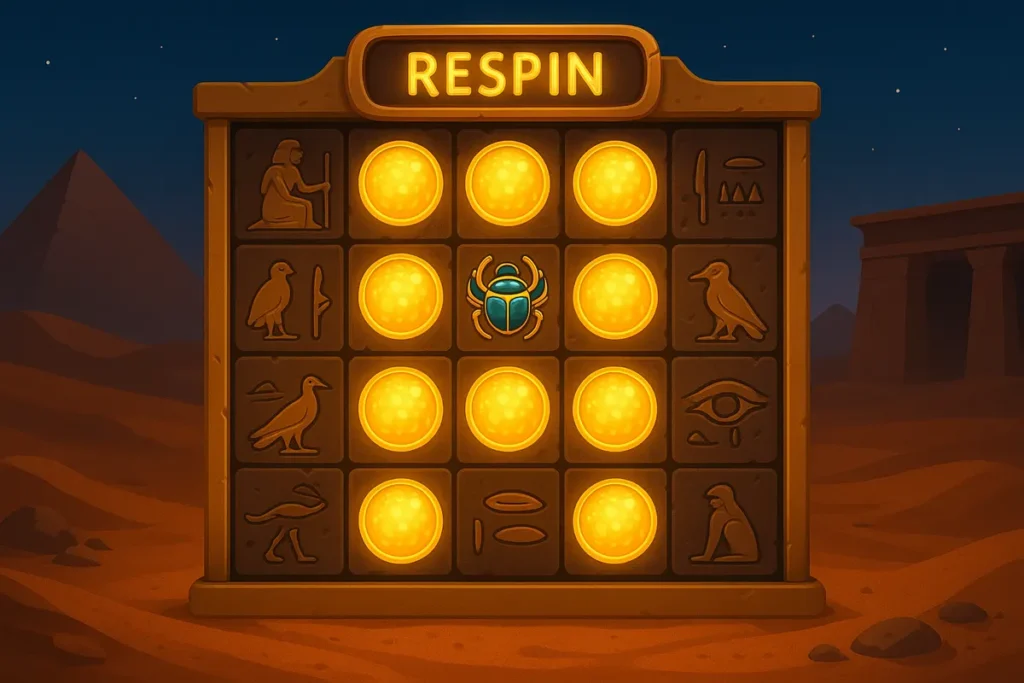
The third coin drops onto the bottom row, the reels freeze, and the game stops being a slot for a moment. The Egyptian symbols fade back, a grid of empty tiles slides forward, three golden coins sit locked where they landed, and a counter in the corner reads 3. That single moment, repeated across thousands of games, is why hold and win slots took over the lobby.
1spin4win’s Lucky Foxilian Hold and Win is a useful example because it’s new, it’s built on exactly this mechanic, and the trigger is refreshingly simple: three or more Coins in one spin. Here’s what actually happens after that, and which of the things players believe about the feature are nonsense.
What are hold and win slots?
Hold and win slots are games where special coin or money symbols lock (“hold”) in place and award a limited number of respins, with the counter resetting every time another coin lands, until the respins run out or the grid fills. The payout is the total value of the coins you collected, not a payline combination.
That’s the whole idea. The base game is a normal slot with reels, symbols and paylines or ways to win. The bonus round is a separate mini-game with its own rules, its own set of symbols, and its own end condition. You’ll also see it sold as Hold and Spin, Link and Win, Cash Collect or Respin Bonus. Same skeleton, different marketing.
In Lucky Foxilian, the base game sends its fox adventurer across the desert chasing a pharaoh’s buried treasury, with scarabs, the Eye of Ra and pharaoh symbols paying across 243 winning ways, and a maximum win the developer puts at up to 1300x the original bet. The Coins are the odd ones out: they don’t form lines, they only count towards the bonus.
Lucky Foxilian at a glance
1spin4win announced Lucky Foxilian Hold and Win as an Egypt-themed addition to its lineup, showcased at SBC Summit 2026. What we know from the release:
- 243 winning ways rather than fixed paylines, so wins are counted by symbol positions across adjacent reels instead of along drawn lines.
- Egyptian symbol set: lucky scarabs, the Eye of Ra, pharaohs and the travelling fox himself.
- Maximum win of up to 1300x the original bet.
- A Hold and Win Bonus round triggered by three or more Coins in a single spin.
1spin4win lists the RTP for Lucky Foxilian Hold And Win at 97.1% (SiGMA World cites the same figure as 97.01%), which matters more than the theme. That sits at the top end of the usual slot range of roughly 94% to 97%, and it works out to a house edge of about 2.9%. Even so, many providers ship multiple RTP versions of the same title for different operators, so open the game’s info or paytable screen before you spin and read the figure your casino is actually running. A game at 96% RTP carries a 4% house edge; at 94% that edge more than doubles to 6%, on identical artwork.
What triggers the hold and win bonus
In Lucky Foxilian, three or more Coins landing in the same spin trigger the Hold and Win Bonus round. Nothing else does. Not a near miss on the fourth reel, not two coins plus a scatter, not a long losing run.
The sequence goes like this:
- You spin the base game at your chosen stake. Coins can land anywhere on the grid.
- Three or more Coins appear on the same spin. Two won’t do it, and coins from the previous spin don’t carry over.
- Those Coins lock into their positions and the bonus round opens, usually with the rest of the symbols cleared away.
- You’re given a set number of respins to add more coins to the grid.
The trigger is the part players misread most often. Coin symbols are typically weighted differently from paying symbols, and in many hold and win games they’re concentrated on certain reels. That’s a design choice inside the RNG, not a pattern you can read off the screen.
How the respin feature works
Once the bonus starts, the game runs on a simple loop. Most hold and win titles give three respins to begin with. Every time a new coin lands, the counter resets to its maximum. Land nothing, and the counter ticks down. When it reaches zero, or when every position on the grid is filled, the round ends and the values on all collected coins are added up and paid.
So a round can last four respins or forty, and the length is decided entirely by how the coins fall. Each respin is an independent RNG event. The counter resetting does not mean the game has “warmed up”, and a long round is not evidence that a big finish is coming.
Two details worth checking in the paytable of any game, including Lucky Foxilian, because they vary between titles:
- Whether the respin counter resets on every new coin or only on certain types.
- Whether filling the entire grid awards an extra prize on top of the coin values.
Multipliers, special coins and jackpot mechanics
The plain version of the mechanic is just coins with fixed cash values. Providers layer extras on top, and these are where hold and win games differ from one another:
| Bonus element | What it does | Why it matters |
|---|---|---|
| Multiplier coins | Multiply the total collected value, or the coins in view, by a set factor | Most of the swing in a big round usually comes from these, not from coin count |
| Collector coins | Absorb the values of other coins on the grid into one position | Concentrates the round total; often paired with multipliers |
| Extra-respin coins | Add respins beyond the usual reset | Lengthens the round without adding value by itself |
| Jackpot coins | Award a fixed or progressive jackpot tier | Usually the rarest symbol in the set; read the qualifying conditions |
| Grid-fill prize | Bonus paid for filling every position | The headline max win in many games, and genuinely rare |
Lucky Foxilian’s cap is stated as up to 1300x the bet. Treat published max wins as a ceiling, not an expectation. On a ₹20 spin that ceiling is ₹26,000, and the probability of touching it in any given session is very small. Free spins, where a game offers them, are a separate feature with separate rules and shouldn’t be confused with the respins inside a hold and win round.
Five things players get wrong about hold and win slots
“It’s due, I’ve been feeding it for an hour”
The RNG has no memory. A game that hasn’t triggered the bonus in 400 spins has exactly the same chance on spin 401 as it did on spin 1. Sessions have no debt to settle.
“Betting max makes the bonus trigger more often”
Trigger frequency is a fixed probability per spin in almost every game. Raising your stake raises the size of both wins and losses, and it burns your bankroll faster, which shortens the number of spins you get. If a title genuinely has bet-linked features, that’s written in the paytable, so look there rather than guessing.
“Two coins on screen means I’m close”
Two coins is a loss. Near misses feel like progress because the game is designed to make them feel that way, with sound and animation doing the work. Nothing carries over to the next spin.
“High volatility means better odds”
Volatility describes the shape of the payouts, not their long-run total. A high volatility hold and win slot pays less often but in bigger chunks; a low volatility one drips. Neither changes RTP or the house edge. Volatility decides how brutal your variance feels, and therefore what stake your bankroll can survive.
“Stopping the respin manually changes the result”
The outcome of a respin is determined when it’s initiated. Tapping the screen, using turbo mode or hitting autoplay changes the speed of the show, not the result. Faster spinning mostly means more spins per hour, which means more money wagered against the same house edge.
Playing hold and win slots without fooling yourself
There’s no strategy that overcomes the house edge in a slot. What you can control is stake sizing, session length and which game you sit down at. That’s it, and it’s still worth doing properly.
- Set the budget before the first spin. Decide the rupee amount you’re willing to lose for the entertainment, and treat it as spent. Deposit limits at the casino level are more reliable than willpower at 1am.
- Size the stake to survive the variance. Hold and win games often go long stretches without a bonus round. A stake of roughly 1% or less of your session budget gives you a few hundred spins; a stake of 10% gives you ten and a very short evening.
- Read the paytable first. RTP, volatility rating, trigger condition, coin types, max win. Two minutes of reading tells you more than an hour of spinning.
- Check the RTP your operator runs. Same game, different versions. If it isn’t displayed, that’s a reason to be cautious.
- Don’t chase the bonus round. Raising stakes to “get the bonus back” is the fastest route to a loss you didn’t plan for.
- Watch the clock. Reality check reminders exist for a reason. Use them.
If the bonus round is starting to feel like a target rather than a feature, take a break and use the deposit limits, cool-off or self-exclusion tools your casino provides. Gambling should cost you an entertainment budget and nothing else, and it’s never a way to make money. If it stops feeling like a game, stop.
FAQ
How do hold and win slots work?
Coin symbols lock in place and award a limited number of respins. Every new coin resets the respin counter, and the round ends when the respins run out or the grid fills. You’re paid the combined value of the coins collected rather than a payline win.
What triggers the hold and win bonus in Lucky Foxilian?
Three or more Coins landing in a single spin. They lock in position and open the Hold and Win Bonus round. Coins from earlier spins don’t count towards the trigger.
How does the respin feature work?
Each respin is an independent RNG event with no connection to the previous one. Landing a coin resets the counter to its maximum; landing nothing drops it by one. Zero respins left, or a full grid, ends the round.
What is Lucky Foxilian’s RTP?
1spin4win publishes an RTP of 97.1% for Lucky Foxilian Hold And Win, a figure also cited as 97.01% by SiGMA World. That’s a house edge of roughly 2.9%. Still check the game’s info screen at your casino, since providers often supply several RTP configurations of the same title. The release also states 243 winning ways and a maximum win of up to 1300x the bet.
Can you improve your chances in a hold and win game?
No. Trigger probability and coin values are fixed by the game’s maths and the house edge applies to every spin. What you can manage is stake size, session length and your choice of game.