

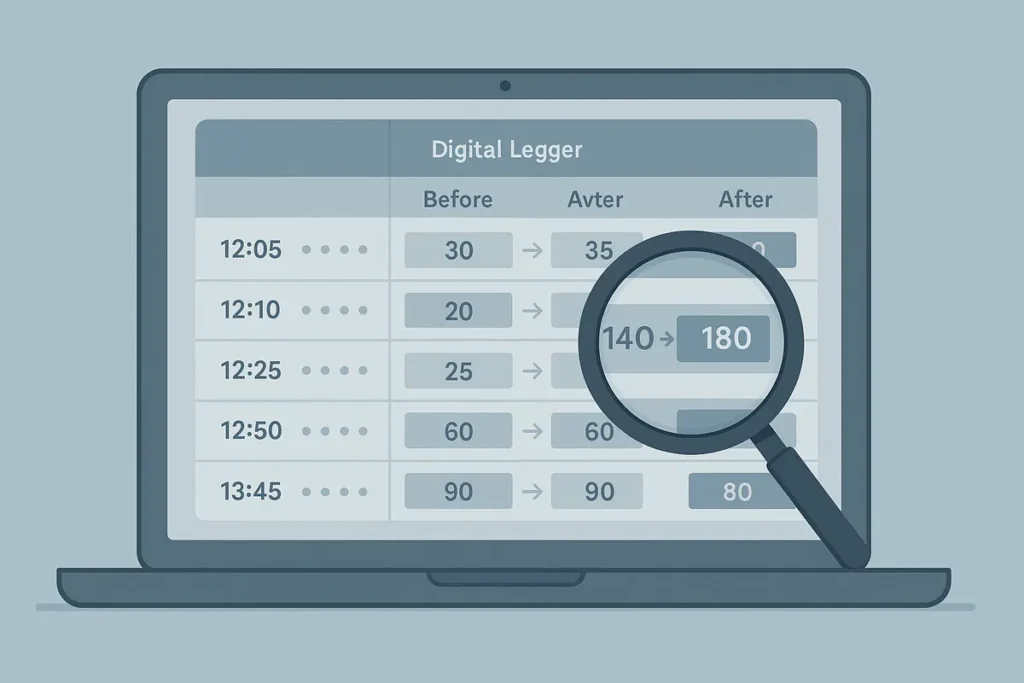
Ever gone to withdraw and found that the bonus terms don’t quite match what you remember reading? That uneasy feeling, the sense that something moved while you weren’t looking, is exactly the problem iGaming audit logs exist to solve. An audit log is a timestamped record of every change made inside an operator’s system: who changed what, when, and what the value was before and after. It sounds like dry back office plumbing. In practice, it is one of the few things that can settle an argument between you and a casino with facts instead of opinions.
Let me walk you through a scenario that plays out on complaint forums more often than it should, and show where a proper audit trail changes the ending.
What are audit logs in online casinos?
An audit log (or audit trail) is an append-only record of system activity. Append-only is the important part: entries can be added but not quietly edited or deleted, so the history stays intact. Each entry typically captures the action, the account or admin that performed it, a timestamp, and the old and new values of whatever was changed.
Think of it as the casino’s version of a bank statement, except instead of tracking money it tracks decisions. A bonus percentage edited. A withdrawal limit lowered. A game’s configuration swapped. A player account flagged. None of those are sinister on their own, operators change things every day for perfectly ordinary reasons. The difference between a trustworthy platform and a shaky one is whether those changes leave a mark that someone independent can inspect later.
For players, the value is simple. Without a log, a dispute comes down to your screenshot against their word. With one, there’s a third source of truth.
The scenario: Rohan’s bonus that changed shape
Rohan, a recreational player in Pune, deposits ₹10,000 and opts into a 100% match bonus with 35x wagering on the bonus amount. He reads the terms page carefully, because he’s been burned before. It says slots contribute 100% to wagering and live casino games contribute 10%. Max bet while the bonus is active: ₹300.
He spends three weeks grinding a mix of slots and live blackjack. When he finally clears what he calculates as the full requirement and requests a payout, support tells him live casino games carry zero weighting, so most of his turnover never counted.
Rohan is certain the page said 10%. Support is certain it says 0%, and right now, on the live site, it does. Here’s where everything hinges on whether that operator keeps a real audit trail.
If it does, someone can pull the change history for the promotion and see something like: 14 March, 09:42 IST, admin user A-118, field “live_casino_weighting” changed from 10 to 0. Rohan opted in on 2 March. That single line reframes the entire dispute, because the terms he accepted are not the terms he’s now being judged against. Complaints handlers and licensing bodies generally work from the version of the terms a player actually agreed to, and a dated log is what proves which version that was.
If the operator keeps no such record, the conversation goes nowhere. Two people, two memories, no evidence. That asymmetry is the real reason change tracking matters to you as a player.
What changes do casino audit logs track?
A well-built audit trail covers far more than promotions. The categories below are the ones that touch players most directly.
| Area | Example logged change | Why it matters to you |
|---|---|---|
| Bonus and promotion terms | Wagering multiplier, game weighting, max cashout, expiry window | Proves which version of the terms applied when you opted in |
| Game settings | A title’s configuration or RTP variant swapped, a game enabled or restricted in a market | Some slots ship in multiple RTP versions; a log shows which was live when you played |
| Payments | UPI or card method added or disabled, minimum withdrawal raised, payout limits edited | Explains why a method that worked last month suddenly doesn’t |
| Player accounts | Limits adjusted, account flagged or restricted, KYC status updated, bonus manually removed | Shows whether a restriction was applied by a staff member and on what date |
| Administrative and access events | Staff logins, permission changes, new admin accounts, exported data | Underpins data integrity, and flags whether an internal account was misused |
| Transaction history | Manual balance adjustments, reversed deposits, corrected payouts | Any hand-edited balance has a named author and a reason attached |
Notice the pattern: none of this is about game outcomes. Round-by-round results sit in a separate game history, and fairness of the randomness itself is handled by RNG certification from independent test labs, or by provably fair verification in crash games like Aviator. Audit logs cover the human layer, the settings people can reach and adjust.
How change tracking builds operator transparency
Four things happen once every administrative change is recorded and searchable.
- Retroactive edits stop being useful. If a staff member can’t alter terms without leaving a dated fingerprint, the temptation to quietly rewrite a promotion after the fact largely disappears.
- Disputes get resolved on evidence. Rohan’s case takes minutes to settle with a log and weeks to argue without one. Good operators actually prefer this, because it also protects them from false claims.
- Regulatory oversight becomes practical. Licensed operators have to demonstrate compliance, not just assert it. Compliance monitoring, anti-money laundering checks and responsible gambling controls all rely on being able to reconstruct who did what and when.
- Internal accountability improves. A named author on every change is a quiet but effective deterrent against both carelessness and insider abuse.
None of this is something you can inspect yourself. You won’t be handed a login to a casino’s back office. What you can do is treat the presence of proper audit trails as one signal among several, alongside a verifiable licence, published game provider certifications, and clear withdrawal terms. Our guide to checking a casino’s licence covers how to verify the regulatory side before you deposit.
ReferOn’s native audit logs and why “native” matters
The clearest recent example of this thinking comes from the affiliate and partner management side of the industry. ReferOn rolled out a native Audit Logs feature in September as a standard, platform-wide update for all existing and new clients, creating a centralised, traceable ledger of platform activity in a single searchable dashboard.
The problem it targets is specific. Operators running several brands through one platform make constant adjustments to commission structures and payment methods. A single untracked change can trigger a costly partner dispute or a compliance headache, because nobody can prove what the arrangement was last quarter.
The word native is doing real work here. Bolt-on third-party logging sits outside the system it’s watching, which usually means gaps: some actions get captured, others don’t, and the records live in a separate tool that may not line up with the platform’s own data. Logging built into the platform captures actions at the source, in one place, with consistent detail and no stitching together of exports. For operators, that turns “we think the commission changed in March” into a searchable entry with a name and a timestamp attached.
Why should an Indian player care about an affiliate platform’s feature release? Because it shows where the industry’s expectations are heading. Change-tracking is moving from a compliance nice-to-have to a default part of the stack. Operators that treat partner-facing accountability as standard tend to apply the same discipline to player-facing systems, and the ones still running without an audit trail anywhere are increasingly the outliers.
Red flags: when an operator can’t show its work
You can’t audit the back office, but weak casino accountability leaks into the player experience in ways you can spot.
- Terms change with no version history or date. Serious operators stamp their terms and promotions with a “last updated” date. No date at all is a choice.
- Rules applied retroactively. You’re told a restriction “has always been there” when your own records say otherwise, and nobody can produce a change date.
- Transaction history you can’t reconcile. Missing entries, balance adjustments with no explanation, or a game history that only goes back a few days.
- Support that never escalates to evidence. Ask directly: “On what date was this term changed?” A well-run operator can answer. Vague deflection tells you there’s nothing to look up.
- No named regulator or dispute route. Without external oversight, there’s nobody to demand the records on your behalf.
- Game rules or paytables that shift without notice. RTP variants exist; silently swapping them with no announcement and no trail is a warning sign.
The practical habit, and it costs you nothing: screenshot the bonus terms on the day you opt in, note the date, and keep your own transaction records. That’s your personal audit trail, and it’s the thing that makes a complaint winnable.
Frequently asked questions
What are audit logs in iGaming?
They are append-only records of system changes inside a gambling operator’s platform, capturing the action, the responsible account, a timestamp, and the before and after values. They cover bonus terms, payment settings, game configurations, account actions and administrative access.
How do audit logs protect players?
By making retroactive changes traceable. If terms or limits were altered after you opted in, a dated log proves it, which is what turns a he-said-she-said dispute into a resolvable case for the operator’s complaints team or its regulator.
Why are audit logs important for casinos?
Licensed operators must be able to demonstrate compliance, reconstruct decisions and defend themselves against incorrect claims. Centralised change tracking also reduces internal errors and supports anti-money laundering and responsible gambling obligations.
Can I see a casino’s audit logs myself?
No. Those records are internal and contain other people’s data. You can request specific information about your own account and dispute dates, and a licensing body or dispute resolution service can compel the operator to produce the relevant entries.
Where this leaves you
Transparency tooling doesn’t change the underlying maths. Every game still carries a house edge, and a casino with immaculate audit logs will still return less than 100% of stakes over time, because that’s how the games are built. What change tracking does is narrow the gap between the rules you were shown and the rules you’re actually held to.
Judge operators on evidence they can produce: a verifiable licence, dated terms, certified games, and support that can tell you when something changed. And set your own limits before you play, not after. Deposit and loss limits, session reminders and cool-off tools exist on every properly licensed site, and using them is the one form of control that’s entirely yours. If gambling stops being entertainment, step away and use the responsible gambling tools and support resources available to you.