

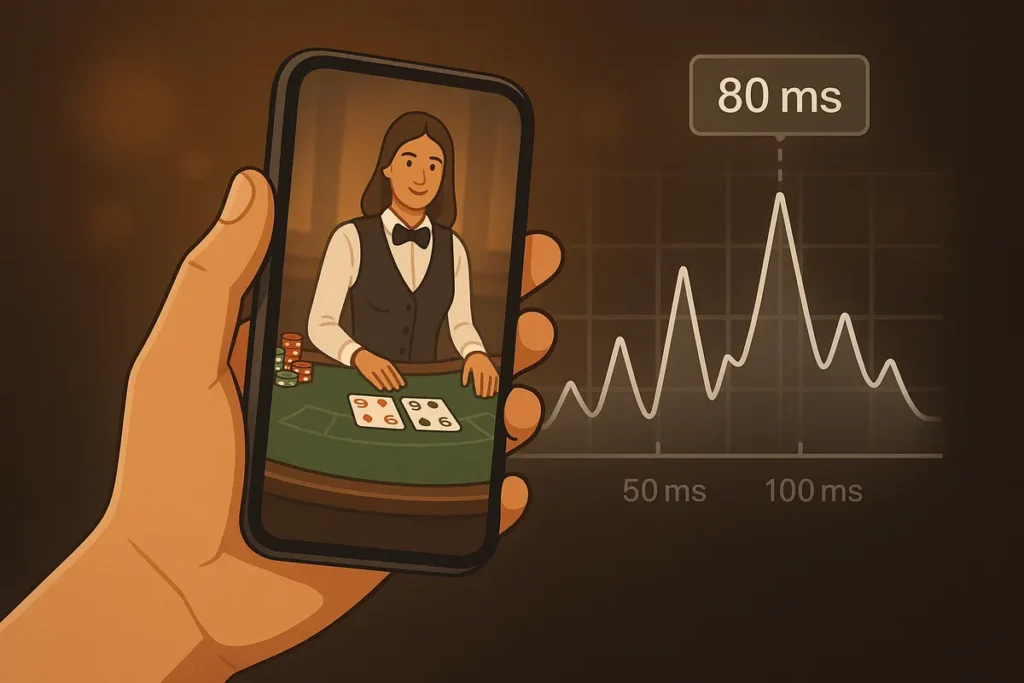
What “igaming platform speed” actually means, and what it doesn’t
iGaming platform speed is how quickly a casino site loads and responds when you tap something. Simple enough. The complication is that “speed” is at least four different things wearing one label: how fast the page paints, how fast your bet reaches the server, how fast the video stream reaches your eyes, and how fast your device can render all of it on a mid-range Android phone over 4G.
The reason this is being talked about at all is a vendor claim. GR8 TECH announced it had rebuilt its platform’s frontend and hit average Lighthouse scores of 90 to 95 with load times of 1.72 seconds, adding that top performers elsewhere in the industry don’t exceed 75 points. Its CTO, Edward Smyshliaiev, framed the benefit in operator language: smoother experience, longer sessions, better retention. Part of the fix was moving from pure client-side rendering in React to server-side rendering, so the page arrives mostly built instead of being assembled in your browser.
That’s a supplier press release, not an independent audit, and a Lighthouse score is a lab measurement of a page, not a promise about your Tuesday night blackjack hand. But the claim is a useful hook, because it points at metrics you can check yourself in about fifteen minutes. And it raises the more interesting question: does platform speed actually change anything for you as a player, or only for the operator’s retention dashboard?
The honest answer is: it depends entirely on what you play.
Where speed really bites: live casino vs crash vs slots
Live casino games: the betting window is your deadline
Live dealer games run on a clock. Roulette gives you a betting window of typically around 20 to 30 seconds, though some sources cite full rounds, including the spin and payout, lasting 45 to 90 seconds. Live blackjack gives you a few seconds to hit or stand, and Teen Patti and Andar Bahar tables move fast. If your bet takes a second and a half to register and the countdown is at 00:02, you don’t get a slightly worse experience. You get no bet.
Two separate delays are at work here. One is stream latency: the video you’re watching is always a little behind reality, often a couple of seconds even on a healthy connection, because it has to be encoded, sent and buffered. The other is action latency, the round trip from your tap to the server and back. Stream lag is annoying. Action lag costs you hands, and on a live blackjack table it can cost you the decision itself, because most operators auto-stand or auto-fold when the timer expires.
If you play live tables regularly, this is the category where platform speed is worth being fussy about. Our live dealer game guides go deeper on how betting windows and table rules differ.
Crash games: responsiveness, not fairness
Crash games feel like the most speed-sensitive thing on the site, and in one sense they are. In Aviator-style rounds the multiplier climbs from 1.00x and you have to cash out before it crashes. Half a second of input lag at 2.30x is a real difference in what you collect.
What lag does not do is change where the round crashes. In a provably fair crash game, the outcome is determined by server and client seeds committed before the round starts, so the crash point is already fixed while the plane is still on the runway. Your connection affects your ability to act in time, not the result you’re acting on. Anyone telling you a faster connection lets you “beat” a crash game is selling something; the house edge is baked into the game math regardless of your ping.
The practical fix most players ignore: auto cash-out. Setting an automatic cash-out multiplier moves the decision to the server side and takes your reaction time and your network out of the equation entirely. If you play crash games on mobile data, use it. There’s more on round mechanics in our crash game guides.
Slots: load times are comfort, not outcome
Here’s where I’ll push back on the industry hype. A slot outcome is decided by the RNG the moment you press spin. A slow-loading game doesn’t shave your RTP, and a fast-loading game doesn’t improve it. A 96% RTP slot returns about ₹96 per ₹100 wagered over the long run on a 1.72-second platform and on a six-second one.
Slow slots cost you patience, data and battery. A game that takes eight seconds to load, stutters on animations and drops your session when you switch apps is a bad product. It is not an unfair one. Judge slots on load time and stability, not on some imagined link between site performance and payouts.
| Game type | What to measure | Good benchmark | What lag actually costs you |
|---|---|---|---|
| Live casino (roulette, blackjack, Teen Patti) | Ping to server, stream stability, bet confirmation delay | Ping under 100ms, no visible buffering, bets confirm instantly | Missed betting windows, auto-stand decisions, rejected bets |
| Crash games | Input responsiveness of the cash-out button | Under 200ms from tap to response | Cashing out lower than intended; nothing to do with the crash point |
| Slots | Game load time, frame stability | Loads in under 3 seconds, no stutter | Time and data, not results or RTP |
| Sports betting in-play | Odds refresh rate, bet acceptance time | Odds update within a second or two | Price changes and bet rejections during fast markets |
What good performance looks like in numbers
You don’t need to guess. Google publishes thresholds that the whole web is measured against, and they translate neatly to casino sites:
- Largest Contentful Paint under 2.5 seconds is rated good; 2.5 to 4 seconds needs work; over 4 seconds is poor. GR8 TECH’s 1.72-second claim sits inside the good band, which is the point it was making.
- Interaction to Next Paint under 200ms is good. This is the one that matters for a cash-out button.
- Lighthouse performance score of 90 to 100 is the green band, 50 to 89 is middling, under 50 is poor. So an industry where the best sites sit near 75 is an industry with room to improve.
- Network ping under 100ms is comfortable for real time gaming. Under 50ms feels instant; over 150ms with jitter is where live tables start to hurt.
Apply these to game launch too, not just the lobby. Plenty of casinos have a quick homepage and a game iframe that takes six seconds to boot.
How to test casino speed yourself
Five checks, all free, none requiring technical skill beyond reading a number.
- Run PageSpeed Insights. Paste the casino’s URL into Google PageSpeed Insights and read the mobile tab first, since that’s how most Indian players actually log in. Look at LCP and INP, not just the headline score.
- Open Chrome DevTools. Press F12 on desktop, go to the Network tab, tick “Disable cache” and reload. The Load figure at the bottom is your real cold load time. Do the same after launching a game and watch how much data the game itself pulls.
- Check your own ping. Run Speedtest and note ping and jitter, not just download speed. A 100 Mbps line with 180ms of latency and heavy jitter is worse for live casino than a 20 Mbps line at 25ms.
- Test at peak hours. Load the same live table at 3pm and again between 9pm and 11pm IST. Server response time under load is what separates a well-built platform from a demo. If it only stutters when busy, that’s capacity, not your phone.
- Read the in-game signals. Most live dealer clients show a connection indicator and a stream quality selector. Crash games show round history with timestamps. Watch for “reconnecting” banners, bets that appear a beat after confirmation, and balances that update late.
Record what you see. Screenshots with timestamps and round IDs are also what you’ll need if a disputed bet ever goes to support.
The technical factors behind your lag
When a casino feels slow, the cause is usually one of five things, and only some of them belong to the operator.
- Server location. Data moves fast but not instantly. A platform served from Europe adds meaningful round-trip time for a player in Chennai compared with a regional edge node. This is physics, not laziness, which is why serious operators use edge infrastructure closer to their markets.
- CDN coverage. A content delivery network caches images, scripts and game assets on servers near you. Good CDN coverage in India is the single biggest lever on first-load times; weak coverage means every asset travels a long way.
- Rendering approach. Client-side rendering ships a bundle of JavaScript and asks your phone to build the page. Server-side rendering sends a mostly finished page. On a flagship phone the difference is small. On a three-year-old budget Android, it’s the difference between two seconds and eight.
- Your connection quality. Jitter and packet loss break live streams more often than raw bandwidth does. Congested 4G, shared Wi-Fi in the evening and VPNs (which add extra network hops) all show up as lag.
- Your device. Twenty open Chrome tabs, low storage and a hot battery throttle performance before the casino gets a chance to.
Before blaming the platform, switch networks once. If a live table is smooth on mobile data and choppy on home Wi-Fi, the problem is at your end.
Red flags worth switching for
Some slowness is cosmetic. Some of it points at problems that have nothing to do with casino load times.
- Bets that fail, then appear on your statement anyway, or balances that settle minutes late.
- Repeated disconnects mid-hand in live blackjack, with no clear rule on how the hand is resolved.
- Cash-out taps in crash games that register visibly after the crash.
- No round history or bet history you can audit afterwards.
- Sessions that drop specifically during deposits, withdrawals or KYC uploads.
- Support that answers every performance complaint with “check your internet” and never a round ID.
The last three are the ones I’d act on. Missing bet history and a support team that won’t engage with specifics are governance problems, and a platform with those issues would worry me even if it loaded in one second flat. Check the licence and terms before the Lighthouse score.
The verdict
Weigh the three categories against each other and the ranking is clear. Live casino is where platform speed genuinely changes what happens to your money, because the betting window is a hard deadline. Crash games come second: speed affects when you can act, never the outcome, and auto cash-out neutralises most of it. Slots come a distant third, where speed is purely about comfort.
So treat vendor speed claims as a signal worth checking, not a verdict. Run PageSpeed Insights, check your own ping, test a live table at 10pm, and see whether the numbers match the marketing. A fast platform makes a better evening. It does not change the house edge, and no amount of network optimisation turns a negative expectation game into a positive one. Set deposit and session limits before you go hunting for a smoother site, and use the responsible gaming tools your operator provides if switching platforms starts to feel like chasing.
FAQ
How do I test casino speed?
Run the site through Google PageSpeed Insights on the mobile tab, then open Chrome DevTools, disable cache and reload to see the real cold load time. Add a Speedtest check for your own ping and jitter, and repeat the whole thing at peak evening hours.
What is good latency for live casino?
Under 100ms ping is comfortable, and under 50ms feels instant. Above roughly 150ms, especially with jitter, you’ll start missing betting windows on fast tables. Remember that video stream delay of a second or two is normal and separate from your action latency.
Why do crash games lag?
Usually because the round updates in real time over a live socket connection, so any packet loss or jitter shows up immediately in the multiplier display and the cash-out button. Server load at peak hours and a heavy JavaScript client on an older phone both add to it. The crash point itself is already set when the round begins, so lag affects your timing, not the result.
How fast should a casino site load?
Aim for a largest contentful paint under 2.5 seconds and a full game launch under about 3 seconds on mobile. Anything past 4 seconds is poor by standard web performance thresholds, and a lobby that loads quickly while games take six seconds still counts as slow.
Gambling should be entertainment you can afford to lose. If it stops feeling that way, use deposit limits, cool-off or self-exclusion. In India the legal gambling age is generally 21, not 18, and legality varies significantly by state and game type, so players must follow the specific laws of their state.